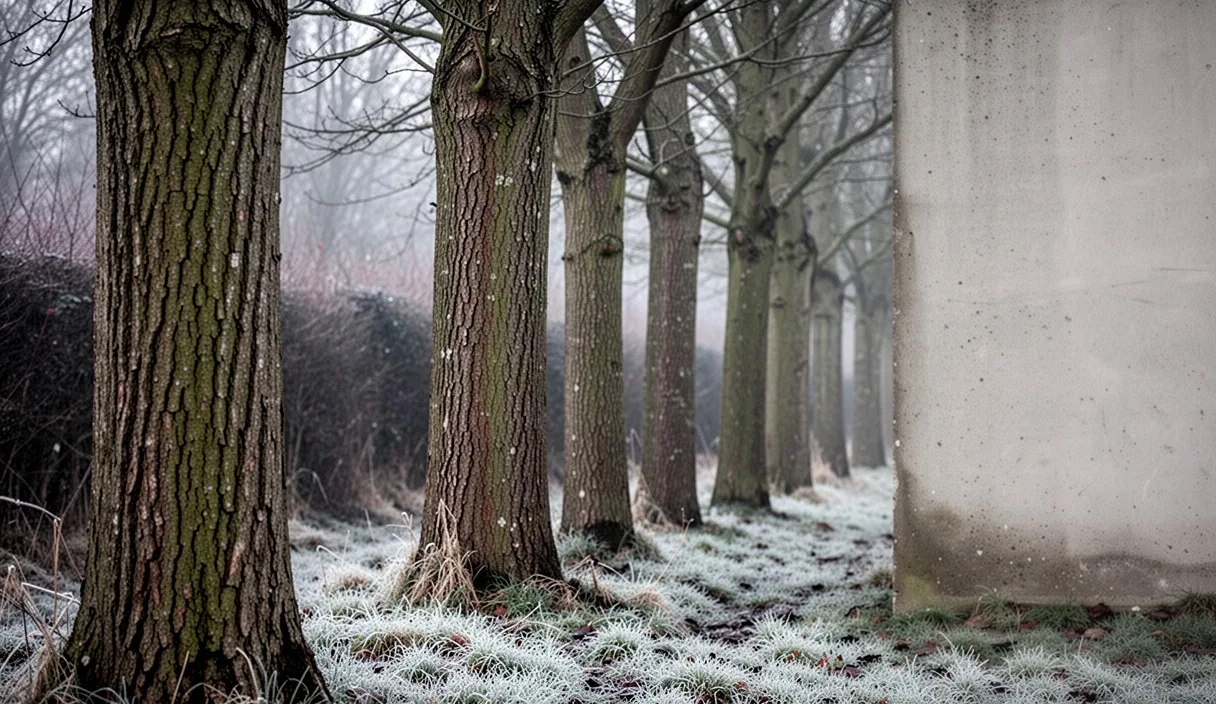
Come November, once the last of the beech leaves have gone copper and dropped, the woods around here strip back to their bones. What's left standing is bark, and bark alone, and if you spend your winters walking the same stretch of hedgerow or coppice you'll start to notice it tells its own story, ridge by ridge. This isn't a party trick for foresters. It's the kind of knowledge that used to be common currency among hedgers, charcoal burners and anyone who needed to know what they were cutting before the sap rose again.
Bracken & Byway readers walking the parish boundaries this time of year will find that a bit of bark literacy changes a plain grey wood into something legible. You don't need a guidebook full of leaf shapes when there are no leaves. You need to know what oak looks like when it's sixty years old and soot-dark from decades of weather, what ash does when it's young versus veteran, and how to tell a birch from a beech at forty paces without breaking stride. That's what this piece sets out to do.
Why bark reading matters once the leaves have dropped
From late October through to March, the standard identification cues, leaf shape, flower, seed case, are simply gone. What remains on a bare tree is silhouette, bud arrangement if you're close enough, and bark. Of the three, bark is the one visible from a distance, in poor light, and on a tree that's been pollarded, coppiced or otherwise altered from its textbook shape.
There's a practical reason woodland managers care about this too. Winter is when most sustainable felling and coppicing happens in British woods, because sap is down and the ground is often firm enough for machinery, and because it avoids disturbing nesting birds. A hedger or timber merchant assessing a stand in January needs to identify species fast, often from a moving vehicle or across a ditch, and bark is the tool for that job.
Bark also ages differently on the same species depending on growth conditions. A fast-grown oak on rich lowland soil can look noticeably smoother at forty years than a stunted hillside oak half its age, so treat every clue as one part of a pattern rather than a fixed rule. The goal is to build a mental checklist: ridge depth, colour, texture, and how the bark behaves near the base versus higher up the trunk.
Oak: deep ridges and dark grey tone
English oak, Quercus robur, is the tree most people think they already know, and in winter it rewards a slow look. Mature oak bark is deeply fissured into vertical, roughly parallel ridges, often several centimetres deep on a tree over eighty years old. The colour sits somewhere between charcoal grey and a brownish grey, darker than ash, and it doesn't have the papery or flaking quality of birch.
Run a hand across it, if the tree is accessible and you're not trespassing on private land, and you'll feel a rough, almost corky texture. On younger oaks, under about twenty years, the bark is smoother and greyer, closer to beech in appearance, which is where people often go wrong. The ridging deepens with age, so a slim oak sapling by a footpath can genuinely fool you if you're only looking for the classic gnarled pattern.
A useful field trick: look at the base of the trunk first. Even young oaks tend to show the beginnings of fissuring right at ground level before the upper trunk catches up, because that part of the bark is oldest and has weathered longest. Sessile oak, Quercus petraea, more common in the north and west, shows a similar bark pattern, so bark alone won't reliably separate the two species, you'd need acorn stalks or leaf shape for that, which of course aren't available in January.
Ash: diamond fissures and pale grey bark
Ash, Fraxinus excelsior, has bark that's easy to mistake for oak from a distance but resolves quickly up close. It's paler, a soft grey rather than oak's charcoal, and the fissures form a distinctive net-like or diamond pattern rather than oak's straighter vertical ridges. On a mature ash, the diamonds can be quite regular, almost basket-woven in appearance.
Younger ash bark is smoother and can look almost silvery-green in patches, especially where lichen has colonised it, which happens often given ash's tendency to grow in hedgerows and field margins with plenty of light and airflow. That lichen growth is itself a rough clue: ash trunks in open hedgerows often carry more lichen cover than a shaded oak in dense woodland, simply because of light exposure, not because of anything inherent to the bark chemistry.
One caution worth flagging here: with ash dieback disease now present across most of the UK, a good number of ash trees you'll encounter on a winter walk may show diamond-shaped lesions or blackened patches on the bark itself, separate from the natural fissuring. These lesions look darker and wetter than the surrounding bark and often sit near old leaf scars or branch junctions. If you're assessing ash on a property or planning any felling near a footpath, get a professional tree inspection rather than relying on a casual bark check, since dieback affects structural safety and there are legal obligations around dangerous trees near public rights of way.
Silver birch: the papery, peeling giveaway
Silver birch, Betula pendula, is the one tree on this list that most people can already name correctly, and for good reason. The bark is white to silvery grey, and on mature trees it peels away in thin, papery horizontal strips, almost like it's shedding a layer of tissue paper. Underneath the peeling layer you'll often see a pinkish or orange-brown tint before it weathers back to grey.
Lower down the trunk, especially on older birches over about thirty years, the bark develops dark, roughly diamond-shaped fissures that can look almost black against the white upper trunk. This creates a two-toned effect: pale and peeling higher up, dark and rugged near the base. It's one of the few British trees where the top and bottom of the same trunk can look like different species entirely.
Downy birch, Betula pubescens, its close relative found more often on wetter, boggier ground, has a similar but slightly duller, browner-white bark that peels less dramatically. If you're walking on heathland or near a bog in Surrey or the New Forest, downy birch is the more likely candidate, while silver birch dominates drier, sandier soils and is the one you'll see self-seeding along railway embankments and waste ground in almost every county.
Beech: smooth bark and where it starts to crack
Beech, Fagus sylvatica, is the smooth one. Its bark stays remarkably unbroken well into old age, a pale silvery grey that can look almost elephant-hide in texture, tight and slightly wrinkled rather than fissured. This smoothness is why beech trunks are the ones you'll find carved with initials going back decades, since the surface takes a mark and holds it in a way rough-barked oak never would.
That said, beech isn't smooth forever. On genuinely veteran trees, often 150 years or more, particularly in chalk downland woods like those across the Chilterns or South Downs, you'll start to see shallow horizontal cracking and a slightly scalier texture near the base, though it never develops anything close to oak's deep ridging. If you're standing in a beech hanger and the bark looks entirely unbroken and silvery all the way up, that's a strong indicator the tree is under a century old.
Beech also holds moss and algae differently to the other species here. Because the bark is so tight and smooth, green algal staining tends to run in vertical streaks following rainwater flow, particularly on the north-facing side of the trunk, which incidentally is an old and reasonably reliable trick for working out compass direction on an overcast day when you've left the map at home.
A quick pocket method for the trail
When you're moving through a wood at pace, you don't have time for a full inspection of every trunk. A three-question method covers most common British species in under ten seconds per tree.
- Is it smooth or fissured? Smooth and silvery points to beech. Fissured rules beech out immediately.
- Is it peeling? Papery horizontal peeling, especially on a pale trunk, means birch, almost always.
- If fissured, what colour and pattern? Dark grey with straight vertical ridges suggests oak. Paler grey with a diamond or net pattern suggests ash.
This little table sums up the four species side by side, useful to memorise before a walk or to photograph and keep on your phone.
| Species | Bark colour | Pattern | Texture |
|---|---|---|---|
| Oak | Dark grey to charcoal | Deep vertical ridges | Rough, corky |
| Ash | Pale grey | Diamond or net fissures | Firm, less deep than oak |
| Silver birch | White to silver, pink beneath | Peeling strips, dark base fissures | Papery above, rugged below |
| Beech | Pale silvery grey | Smooth, minimal cracking | Tight, wrinkled, elephant-hide |
Common mistakes
The most frequent error is judging oak and ash purely on colour from a distance, since both can appear grey in flat winter light. Get closer and check the fissure pattern, straight ridges for oak, diamonds for ash, rather than relying on tone alone.
Another common slip is assuming all birch bark is uniformly white. Downy birch and weathered silver birch can both look duller and browner than the postcard image, so check for the peeling habit and the dark base fissures rather than colour alone.
People also tend to misjudge age from bark texture on a single glance. A young oak with smoother bark can be mistaken for beech, and a heavily lichen-covered ash can be mistaken for something else entirely. Always check at least two features, colour and pattern, or pattern and texture, before settling on an identification.
Next steps for your winter walks
Pick one local wood you already know well and do a slow circuit this month, naming each trunk before you look up at the silhouette to check yourself. Ten or twelve trees is plenty for one outing. Keep a small notebook or your phone's notes app and jot down anything that doesn't fit the patterns above, since local variation is common and half the pleasure of this is building your own regional eye rather than following a guidebook blindly.
If you're responsible for land with mature or veteran trees, particularly ash showing dark lesions or any tree with significant lean or visible cavities, arrange an assessment with a qualified arborist before winter maintenance work rather than making felling decisions on bark identification alone. Bark reading is a genuinely useful skill for a walk, but it isn't a substitute for professional tree health inspection where safety, disease control or legal duty of care are involved.